

When a handrail is installed on a new pool, anchors are typically poured into the deck so the handrail or ladder can sit securely in place. These pre-installed anchors allow the handrail to be removable and properly bonded when required.
If a handrail was not installed when the pool was built, there are still several ways to add one.
Quick Answer: Can You Add a Handrail to an Existing Pool?
Yes, you can add a handrail to an existing swimming pool by cutting and re-pouring part of the deck, core drilling anchor holes, or using on-deck mounted anchors. The best option depends on your deck material, handrail style, installation budget, and whether the handrail requires bonding.
Pool Handrail Installation Options Compared
Before choosing an installation method, consider how much work you want to do to the existing deck, whether you prefer a removable handrail, and what bonding requirements may apply to the handrail material.
|
Installation Option |
Best For |
Difficulty |
Main Watch-Out |
|---|---|---|---|
| Cut and Re-Pour Anchor Cups | Traditional anchor-cup installation | High | Requires deck cutting, concrete work, and bonding |
| Core Drill Anchor Holes | In-deck installation without cutting a large deck section | Medium to High | Requires accurate drilling and proper bonding |
| On-Deck Mounted Anchors | Less invasive installation on concrete or wood decks | Lower | Requires the correct anchors and drill bit for the deck type |
| Polymer Handrail | Avoiding metal bonding requirements | Lower to Medium | Confirm product instructions and local code requirements |
Before You Start
Before adding a handrail to an existing pool deck, it helps to confirm a few details first:
-
Confirm your deck material, such as concrete, wood, or another surface.
-
Choose the handrail style and anchor type before drilling or cutting.
-
Review the manufacturer’s installation instructions.
-
Mark the handrail location carefully.
-
Keep drilling debris out of the pool.
-
Confirm bonding requirements with a licensed electrician when using metal handrails.
Safety Note: Metal pool handrails often need to be properly bonded according to applicable electrical codes. Because bonding requirements can vary by location and installation type, a licensed electrician should verify the connection before the handrail is used.
Option 1: Cut and Re-Pour the Deck for Handrail Anchors |
|
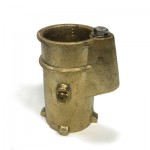 |
One option is to cut a small section of the deck, between the ladder cup placement and the edge of the pool wall so the cups can be installed and a bonding wire attached to the pool structure. Once this is done, place the handrail anchors cups in the cut section, attach bonding wire (#8 copper wire) to anchor cups then connect to bonding wire that runs around the perimeter of the pool, at pools edge or grid. Then re-pour that section of deck. This option is more time-consuming than most other options because it requires cutting and re-pouring part of the concrete deck. It may also be difficult to create a seamless finish. When cutting the deck, make sure the section is large enough to install the anchor, but not so large that it compromises the pool structure or causes the deck to crack. Although this can be done by a homeowner, it is highly recommended that a licensed electrician bond the handrail to the pool structure according to local codes and requirements. Want to avoid bonding altogether?Check out our selection of Saftron pool handrails. These polymer handrails are designed so grounding or bonding is not required. |
Option 2: Core Drill Anchor Holes Into the Existing Deck |
|
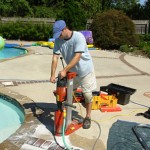 |
Another option is to rent a “core drill” to drill anchor holes into your deck. With the core drill option, you need to ensure to properly mark the location of your handrail, then start drilling. Remember the common motto here: “Measure Twice, Cut Once.” While drilling, be sure not to over-heat the drill and to keep debris from getting into the pool. After the holes are drilled and the core removed, you have several variations prior to installing the handrail. First, you could put pea gravel in the bottom of the hole to stop the hand rail from going to deep and to assist in holding it in. Second, you could insert a PVC sleeve in the hole in addition to the pea gravel. If you chose this variation, be sure to choose a piece of PVC barely large enough for the handrail to slide into, you will also have to drill the hole in the deck larger to allow for the PVC sleeve to be inserted. Third, you can pour a small amount of Quikrete into the bottom of the drilled hole to create a stop for the handrail. If you choose this option, only use enough Quikrete to create a base. If you pour in too much, the handrail will not fit properly. Also, unless you want the handrail to be a permanent fixture, allow the Quikrete to set completely before inserting the handrail into the hole. Although this can be done by a homeowner, it is highly recommended that a licensed electrician bond the handrail to the pool structure according to local codes and requirements. |
Option 3: Use On-Deck Mounted Anchors |
|
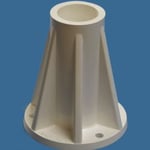 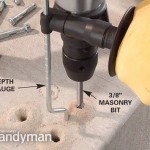 |
The final option is very simply and not as intrusive to your deck. This option utilizes an “On-Deck Mounted Anchor.” Like the other options, you will need to carefully mark the location of your handrail before drilling. With this option, you will only need a drill and a masonry drill bit. Once you have marked the location for both deck-mount anchors, drill the appropriate holes for the anchor bolts. Most deck mounted anchor sets will come with the necessary hardware for installation. Now you are ready to install the anchors to the deck, then install the handrail in the anchors. This option can be used with either a concrete or wood deck. Be sure to use the proper drill bit and anchors for your deck type.
|

Alternative Option: Polymer Handrails
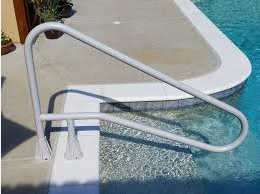
The easiest option for many existing pool decks is to install an “on the deck” polymer handrail. This style of handrail does not require bonding or cutting out a section of the deck, making it one of the simpler installation options.
This installation is similar to Option 3 because the handrail uses deck flanges. Once the flanges are installed, the handrail can be slipped into place.
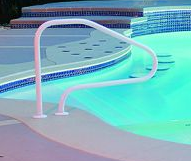
If you prefer a more traditional look, there are also polymer handrails designed in a more familiar pool handrail style. These can be installed into the deck using a core drill, similar to Option 2. This handrail style also does not require bonding to the pool structure.
Both styles are non-corrosive, strong, and low maintenance. Always confirm that the handrail meets local code requirements and follows the manufacturer’s installation instructions.
 |
 |
| Diagram 1 | Diagram 2 |
With the first two installation options, be sure to get escutcheons for your handrail. Escutcheons help finish the look where the handrail meets the deck.
Final Bonding Reminder
Now don’t forget to bond your handrail, and you’ll be all set!
If you install a metal handrail, it may need to be properly bonded. In many installations, the bonding wire can be tied into the bonding wire that runs underground around the perimeter of the pool.
A simple saw-cut section in the deck, running from the newly installed handrail cups to the bonding wire at the edge of the pool, may be suitable. This can help avoid running the bonding wire all the way back to the equipment pad.
Because pool bonding is safety-sensitive, it is best to have a licensed electrician verify the work and confirm local code requirements.
Frequently Asked Questions
What is the easiest way to add a handrail to an existing pool?
For many existing pool decks, on-deck mounted anchors or compatible polymer handrails are the simplest options because they do not require cutting and re-pouring a section of the deck.
Do pool handrails need to be bonded?
Metal pool handrails often need to be bonded according to applicable electrical codes. Polymer or non-conductive handrails may not require bonding, but you should always confirm the product instructions and local code requirements before installation.
Can on-deck mounted anchors be used on wood and concrete decks?
Yes, on-deck mounted anchors can be used on either concrete or wood decks, as long as the correct anchors, drill bits, and installation hardware are used for the deck material.
What should I check before installing a pool handrail?
Before installing a handrail, confirm your deck material, handrail style, anchor type, placement, and bonding requirements. It is also important to follow the manufacturer’s instructions and check local code requirements.