


Considering a swimming pool this year but aren’t sure what the different pool bottom descriptions mean? The pool bottom you choose can affect how your pool feels, how deep it gets, how people use it, and how much excavation may be needed.
There are a few common pool bottoms to choose from, including Standard, Wedge, Sports, Play, Flat Bottom, and Coved Flat Bottom. Here’s what each one means.
Quick Answer: What Are the Most Common Pool Bottom Shapes?
The most common inground pool bottom shapes include standard, wedge, sports, play, flat, and coved flat bottoms. A standard bottom is common for pools with a shallow end and deeper hopper, while sports and play bottoms are popular for pool games. Flat bottoms are simple and consistent, while coved flat bottoms can help create a deeper shallow end or deeper flat-bottom design.
Pool Bottom Shapes Compared
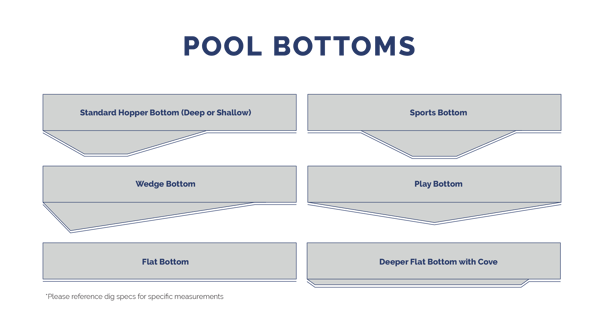
Each pool bottom shape is designed for a different use. Some are better for a traditional shallow-to-deep layout, while others are better for games, lounging, or simpler installation.
|
Pool Bottom Type |
Best For |
General Shape |
Watch-Out |
| Standard Pool Bottom | Traditional shallow-to-deep layout | Shallow end, transition slopes, and deep hopper | Requires more excavation than shallow pool designs |
| Wedge Pool Bottom | Gradual slope and beach-like entry feel | Slopes from the shallow end to the deepest point | Does not have a large flat deep-end hopper |
| Sports Pool Bottom | Volleyball, water polo, and active play | Shallow ends with a deeper center hopper | Not as deep as a diving-style pool |
| Play Pool Bottom | Family recreation and games | Gradual slope from both ends to a deeper center | Less aggressive than a sports bottom |
| Flat Pool Bottom | Laps, simple games, and easier installation | One consistent depth across the pool | Limited depth variation |
| Coved Flat Bottom | Deeper shallow end or deeper flat bottom | Sloped cove from the wall to a deeper floor | Step area may need a ramp shape |
Standard Pool Bottom
This is the most common type. After all, it is standard for a reason.
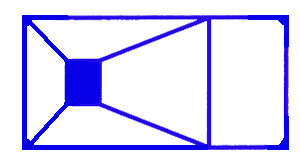
The pool bottom has a good-sized shallow end, a transition slope down to the deep end, a flat hopper, which is the deepest part of the pool, then a slope back up to the deep-end wall.
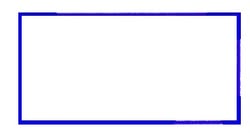
Please see the diagram. The hopper, or deepest portion, is designated by the solid blue rectangle in the diagram. The lines inside the pool designate the edges of the transition, back, and side slopes, which extend from the height of the pool panels, typically 42" or 48", down to the hopper.
Wedge Pool Bottom
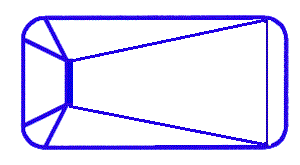
The wedge is a unique design. The wedge pool can be made with either a small flat landing area in front of the step or with no flat sections at all.
It has a very mild, gradual slope from the shallow-end wall all the way to the deepest point. Instead of having a flat hopper section, the pool simply slopes back up to the wall.
Think of this more like how you enter the water at a beach: slow and steady.
Sports Pool Bottom
This type of pool bottom is very popular among those who play pool sports such as volleyball or water polo.
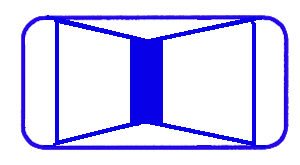
In the sports bottom pool, there is a flat shallow section on both ends of the pool. After the shallow sections on both ends, the pool slopes down to a small hopper in the center, which is typically around 5' to 6' deep.
This type of pool is not as deep as a diving pool, so it heats faster, as is true with all shallower pool types.
Play Pool Bottom
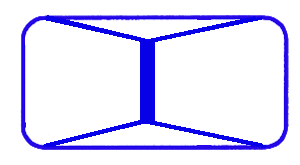
This is a cross between the wedge and sports bottoms. This pool has a gradual slope from both ends of the pool down to a deep point in the center.
The deep point is typically about 5' to 6' deep. This type of pool is also popular among those who play sports, but it is less aggressive than the sports bottom.
Flat Pool Bottom & Deep Flat Pool Bottom
The next two types of pool bottoms are very similar. One is the flat bottom, and the other is a deep flat bottom achieved with a cove.
The flat bottom pool is simply a flat, even surface across the entire pool. A flat bottom pool with 42" wall panels will be about 36" deep. This accounts for 42" wall panels, a pool base built up 2", and a water level typically 6" below the top of the pool wall.
With the same logic, a flat bottom pool with 48" wall panels will be about 40" deep.
If you’re planning on using your pool primarily for swimming laps or playing simple sports like water volleyball, a flat pool bottom may be just right for you. Since flat bottom pools are one continuous depth, generally based on the height of your pool walls, there is much less digging required. This makes a flat bottom pool one of the easiest pool bottom options to install.
There is also an option to have a deeper flat bottom pool using a method referred to as the cove method.
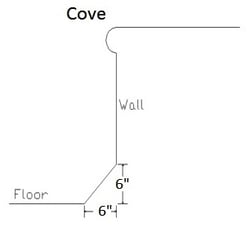
The cove method is an easy way to achieve a deeper shallow end or deeper flat bottom with a 42" or 48" panel. Instead of the pool bottom being completely flat, there will be a cove, which is basically a slope away from the wall down to the desired deeper shallow-end or flat-bottom depth.
The length of the cove will depend on how deep you would like the shallow end or flat bottom to be. The only other consideration when choosing to cove the shallow end for a deeper shallow end is that you will also need to shape a ramp in front of the step so there is something to step onto when you get in the pool.
Please see the diagrams for more information.
Note: Pool bottom depths and slopes can vary based on pool size, wall panel height, liner type, and custom design requirements. Always confirm the final layout and depth with your pool designer before ordering or excavating.
Which Pool Bottom Is Right for You?
If you want a traditional shallow-to-deep layout, a standard bottom may be the best fit. If you want a gradual slope, a wedge bottom may feel more natural.
If your family plans to play volleyball, water polo, or other pool games, sports or play bottoms are often better choices. If you prefer a simple, consistent depth or want an easier installation, a flat bottom may be the right direction.
Keep in mind that we can also customize your pool’s bottom if you have something in mind that you’re not seeing listed.
Pool Bottom Shapes and Terms FAQs
What is the most common inground pool bottom?
- The standard pool bottom is one of the most common options. It includes a shallow end, transition slopes, and a deeper hopper area, making it a familiar choice for many inground pool designs.
What pool bottom is best for volleyball or pool games?
- Sports and play pool bottoms are often good choices for pool games. A sports bottom has shallow areas on both ends with a deeper center, while a play bottom has a more gradual slope from both ends toward the middle.
Is a flat bottom pool easier to install?
- A flat bottom pool is often easier to install than designs with deeper hoppers or more complex slopes because it usually requires less digging and shaping.
What is a coved flat bottom pool?
- A coved flat bottom uses a gradual slope, or cove, from the pool wall down to a deeper flat-bottom area. This can help create a deeper shallow end or a deeper consistent-depth pool.
Can I customize my pool bottom shape?
- Yes, pool bottoms can often be customized depending on the pool design, wall panel height, liner type, and installation requirements. If you do not see the exact bottom shape you want, ask about custom pool bottom options.

.jpg?width=700&name=Royal%20Swimming%20Pools%20INstallatin%20Team%20(9).jpg)