

Best Energy-Efficient Pool Heater: Heat Pump
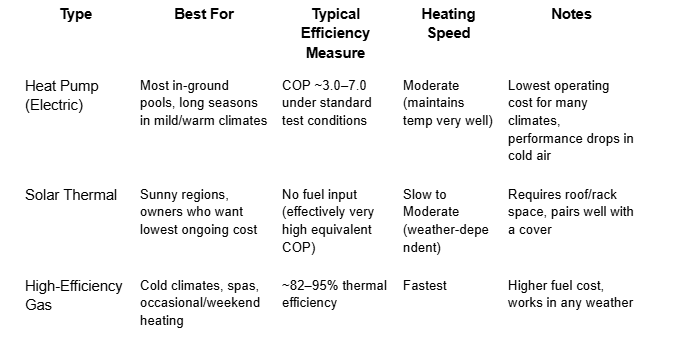
Heating your pool extends the season, but it can drive up energy costs. For most backyards, a heat pump pool heater is the most efficient way to hold a steady temperature with minimal fuss. If you want the lowest ongoing cost, solar can serve as the primary heater—or pair with a heat pump—in sunny regions. When you need rapid, on-demand warmth for chilly weekends or a connected spa, a high-efficiency gas heater remains the quickest option.
Top Picks At A Glance
- Best Overall: Heat Pump Pool Heater. For many pools, heat pumps deliver the best long-term efficiency and steady temperatures with far lower operating costs than gas in mild-to-warm climates.
- Best Budget to Run: Solar Heating System. Higher upfront cost but near-zero operating cost and very low maintenance once installed.
- Best For Quick Heat: High-Efficiency Gas Heater. Fastest warm-up and works in any outdoor temperature making them ideal for colder regions, spas, or occasional use.

Types of Energy-Efficient Pool Heaters
If you’re comparing pool heating options, focus on how quickly you want heat, the climate you live in, and what you’ll spend to run the system over time. Here’s a quick rundown:
Heat Pump Pool Heaters (Most Popular & Efficient)
How They Work: A heat pump moves heat from the outside air into your pool water, like an air conditioner in reverse. A fan draws air across an evaporator coil, refrigerant absorbs heat and is compressed, and that heat transfers into the pool via a titanium or cupro-nickel heat exchanger.
Efficiency
-
- Coefficient of Performance (COP): Typically falls between 5.0 and 6.5 for quality residential models. In broader use, COP values generally range from 3.0 to 7.0, depending on conditions.
- Best For: Pools in mild to warm climates where daytime air temperatures remain above 50°F during swim season.
Pros
-
- Low Operating Cost: Thanks to high efficiency, heat pumps can cost significantly less to run than gas heaters in suitable climates.
- Durability: With basic upkeep, many units last 10–15 years or longer.
- Quiet & Low Maintenance: Scroll compressors and variable-speed fans provide quiet operation with minimal maintenance needs.
Cons
-
- Slower Heat-Up: Heat pumps excel at maintaining water temperature but take longer to raise it significantly.
- Cold-Weather Limitations: Efficiency drops sharply below 50°F, making them less effective in colder climates or during shoulder seasons.
Top Models
-
- Hayward HeatPro 140K BTU: Equipped with a titanium heat exchanger, digital controls, and a listed COP near 6. Designed for saltwater pools and compatible with automation systems.
- Pentair UltraTemp 140K BTU: A high-efficiency heat/cool unit featuring a 100% titanium heat exchanger for corrosion-resistant performance, automatic defrost for low-temperature operation, an LCD control board with full-word readouts, and compatibility with automated control systems.
- Moov 140K BTU Variable Speed Inverter Heat/Cool Pump: a full-inverter unit that modulates compressor speed from 20–100% for high efficiency, provides both heating and cooling with reversible-valve defrost, and delivers a COP around 8 versus the 4–5 typical of many standard heat pumps.
- Hayward HeatPro 140K BTU: Equipped with a titanium heat exchanger, digital controls, and a listed COP near 6. Designed for saltwater pools and compatible with automation systems.
Solar Pool Heating Systems (Zero Operating Cost)
How They Work: Your filtration pump circulates water through roof- or rack-mounted polypropylene solar collectors. Sun-warmed panels raise water temperature before it returns to the pool.
Efficiency
-
- Fuel-Free Heating: No energy cost after installation. Output varies based on sun exposure, panel size, and mounting orientation.
- Best For: Homes in sunny regions with enough usable roof or yard space.
Pros
-
- Minimal Operating Cost: Ongoing cost is limited to the existing circulation pump’s electricity.
- Longevity: Most systems last 15–20 years with little required maintenance.
- Environmentally Friendly: No combustion, emissions, and little added electrical demand.
Cons
-
- Upfront Investment & Space Needs: A complete system may run $3,000–$6,000 or more, and requires sufficient mounting space.
- Weather Dependent: Performance varies with sunlight availability, meaning cloudy days and winter months reduce effectiveness.
High-Efficiency Gas Heaters (Fast but Costly)
How They Work: These systems burn natural gas or propane to heat water as it passes through a copper or cupro-nickel heat exchanger, delivering rapid temperature increases regardless of outdoor conditions.
Efficiency
-
- Thermal Efficiency: Most models achieve ~82–95% efficiency, with condensing units reaching the top end.
- Best For: Pool owners in colder climates, or those with attached spas or occasional heating needs that demand speed.
Pros
-
- Fastest Heating: Ideal for quickly raising water temperature by 10–20°F, perfect for weekend use or spas.
- Unrestricted by Weather: Functions efficiently in any temperature, including cold nights and early or late-season conditions.
Cons
-
- Higher Operating Cost: Fuel prices and lower efficiency vs. electric options make these more expensive to run.
- Installation Requirements: Needs a gas line or propane tank along with venting and clearance, which increases install complexity.
Top Models
-
- Pentair MasterTemp 400k BTU Natural Gas Heater: MasterTemp pool heaters deliver high efficiency, reliability, and quiet operation in a compact design. The user-friendly LCD display with diagnostic icons makes operation and monitoring simple, while the heavy-duty cupro-nickel heat exchanger resists corrosion in demanding conditions such as low pH, high flow, and heavy use.
- Hayward Universal 400k BTU H-Series Natural Gas Low NOx Heater: Provides fast, energy-efficient heating with a corrosion-resistant cupro-nickel heat exchanger and easy-to-use controls. This 400,000 BTU natural gas heater offers reliable performance with electronic ignition, Low NOx emissions, and flexible installation.
- RayPak Digital 266k BTU Natural Gas Low NOx Heater: ASME-rated low-NOx heater featuring a copper fin-tube heat exchanger, corrosion-resistant galvanized cabinet, ProTek Shield self-protection module, and a digital LCD with microprocessor diagnostics for precise temperature control and continuous status monitoring.
- Pentair MasterTemp 400k BTU Natural Gas Heater: MasterTemp pool heaters deliver high efficiency, reliability, and quiet operation in a compact design. The user-friendly LCD display with diagnostic icons makes operation and monitoring simple, while the heavy-duty cupro-nickel heat exchanger resists corrosion in demanding conditions such as low pH, high flow, and heavy use.
Best Pool Heaters by Pool Type
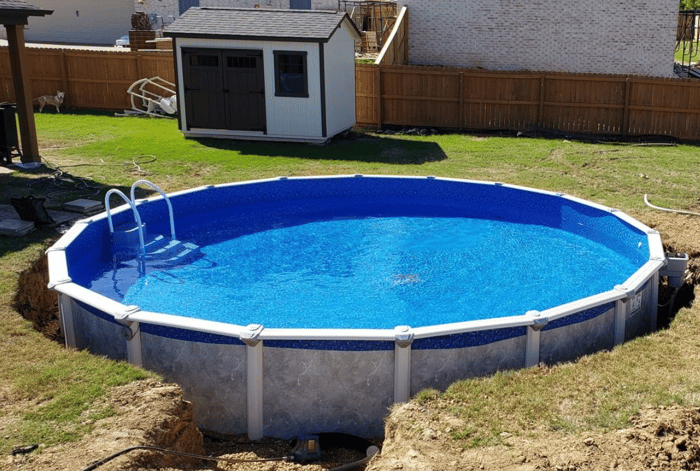
In-ground pools typically benefit from higher-capacity systems with long-term efficiency, while above-ground setups often prioritize space-saving, plug-in convenience or budget-friendly solar kits. Here’s how to match the right heating option to your pool type.
Best Pool Heaters for In-Ground Pools
- Heat Pumps: For most in-ground pools, heat pumps offer the best combination of energy efficiency, reliability, and low operating cost. They excel at maintaining steady temperatures during the season and perform well in moderate to warm climates. Look for models with titanium heat exchangers for saltwater compatibility and a high Coefficient of Performance (COP) to ensure maximum return on energy use.
- Solar Systems: In regions with strong sun exposure, a well-sized solar array can cover most or all of your pool’s heating needs with minimal ongoing costs. For year-round use or to handle seasonal dips, many owners combine solar with a backup gas heater or heat pump, especially for spring warm-ups or early fall swimming.
Best Pool Heaters for Above-Ground Pools
- Heat Pumps (Plug-and-Play or Compact Units): For most above-ground pools, a small air-source heat pump also delivers the best balance of comfort and operating cost in mild to warm climates. These units draw heat from the air and can deliver roughly 4–5 units of heat for every unit of electricity, which makes them far more efficient than straight electric resistance heaters and a strong fit for season extension on smaller pools.
- Compact Gas or Propane Heaters: For cold climates, shoulder-season use, or pools that only run on weekends, a small gas or propane heater heats water much faster than solar or a heat pump at the expense of higher fuel cost. These are the go-to when you value on-demand warmth over efficiency, provided you have safe access to a gas line or propane supply.
How to Size a Pool Heater Correctly
A properly sized unit heats efficiently, maintains your desired temperature, and avoids unnecessary wear. Use the steps below as a starting point, and consider a professional load calculation for the most accurate results.
Why Sizing Matters
- Undersized Units: These work harder than they should, running constantly, inflating energy bills, and wearing out faster than necessary.
- Oversized Units: Higher upfront cost and, in the case of gas heaters, may lead to short-cycling, which reduces efficiency and service life.
1. Basic Sizing Formula (Surface Area Method)
To estimate the required heating capacity:
BTU/hour = Pool Surface Area (sq ft) × Temperature Rise (°F) × 12
Example:
A 400 sq. ft. pool with a 20°F desired increase would need:
400 × 20 × 12 = 96,000 BTU/hour
This formula assumes light wind conditions and aligns with standard industry benchmarks (typically a 1–1.25°F increase per hour with moderate air movement). If faster temperature rise is important—such as for weekend use or spa add-ons—consider increasing capacity beyond this baseline.
2. Other Factors That Affect Sizing
- Wind, Humidity & Night Temps: Pools in windy or dry climates lose heat more quickly, especially at night. Exposed or elevated installations often require additional heating capacity.
- Use a Cover: A solar blanket or liquid pool cover significantly reduces heat loss, often cutting heating requirements by up to 50% or more in real-world use.
- Frequency of Use: Daily swimmers benefit from a heat pump that maintains water temperature efficiently over time. For occasional use, especially in colder areas, gas heaters may be better suited for rapid heating.
- Location & Season Length: Cooler climates or shorter swim seasons typically require more BTUs. In these cases, a hybrid system—solar for baseline heat and a gas or heat pump unit for boosts—can provide flexibility and savings.
Pro Tip:
Start with this comprehensive article, What Size Pool Heater Do I Need?. It walks you through pool volume, climate, and target temperature step by step so you can dial in the right BTU range before you start comparing specific models.
Tips to Maximize Pool-Heating Energy Efficiency
Small tweaks can make the most efficient pool heater even better:
- Use a Cover or Liquid Blanket: Reduces heat loss by up to ~50–70% when the pool isn’t in use. Covers also curb evaporation and chemical loss.
- Dial In Water Chemistry: Balanced chemistry prevents scale on heat-exchanger surfaces, keeping efficiency and flow where they should be.
- Aim For 78–82°F: Most families enjoy 78–82°F. Each degree above that can add around 10–30% to heating costs, depending on conditions.
- Time Your Heat: If your utility offers off-peak electricity rates, schedule heat-pump operation to match. Otherwise, run the heat pump during the warmest daylight to maximize COP.
- Pair Technologies: In sunny regions, use solar for baseload and a heat pump for top-offs. Spa nights? Keep a gas heater for rapid boosts.
- Mind The Wind: Windbreaks (fences, hedges) and proper equipment placement can lower heat loss and short-cycling.