

How Much Does It Cost to Fill a Pool in the US?
Filling a swimming pool isn’t once and done. It’s a real, recurring cost that often surprises new pool owners. Whether it’s your first fill after construction, a refill after draining for repairs, or topping off after heavy evaporation, the amount of water (and money) involved can add up quickly. Costs vary based on your location, water provider, pool size, and how often you lose water to splash-out, leaks, or dry weather.
In this guide, we’ll walk through average fill costs for common pool types, break down how much water different pools actually hold, and explore water-saving tips—backed by EPA guidance—that help stretch every gallon. We’ll also look at alternative water sources and smart ways to reduce your pool’s long-term water bill.
Average Pool Water Volume in the U.S.
Knowing how much water your pool holds is the first step to budgeting for your initial fill and future top-offs. In the U.S., a typical in-ground backyard pool often holds 18,000–20,000 gallons, a common size being 16’ × 32’ with a mid-range depth. Above-ground round pools vary more based on diameter and fill depth (since you don’t fill them to the brim). A standard 18’–24’ round pool usually holds around 8,500–14,000 gallons.
Shape and depth matter. A deep “hopper” for a diving end or a wide surface area can easily add several thousand gallons.
Formula Highlights (Estimate Gallons)
Use feet for all measurements and the average water depth (not wall height). These multipliers are most accurately based on 1 cubic foot = 7.48 gallons, however many charts and rule-of-thumb guidelines round it to 7.5 for convenience:
Rectangular (and most straight-wall freeform sections):
- Quick Method: Length × Width × Average Depth × 7.5
Round Pools:
- Quick Method: Diameter × Diameter × Average Depth × 5.9
(Uses π/4 × 7.48 ≈ 5.9)
Oval / Elliptical (also works for many kidney and freeform pools):
- Quick Method: Length × Width × Average Depth × 5.9
Average depth = (Shallow Depth + Deep Depth) ÷ 2
For hopper bottoms or complex shapes, break the pool into simple sections (like rectangles and ovals), calculate each separately, then add the totals.
Accuracy Tips
- Use water depth, not wall height: A 52” wall usually holds closer to 48”–50” of actual water.
- Expect variance: Rounding constants (7.48 vs. 7.5) and depth assumptions can shift estimates by a few hundred gallons.
- Example: A 16’ × 32’ rectangle with 3.5’ shallow and 6.5’ deep (average depth 5.0’): 16 × 32 × 5 × 7.5 = 19,200 gallons.
- Use our calculator for odd shapes: For kidney and freeform pools, plug in your dimensions and depths using the Royal Swimming Pools Gallon Calculator for a more precise estimate.

The Real Cost of Filling a Swimming Pool
Refilling from a municipal tap is usually the lowest-cost option, but your total depends on pool size and your local “per 1,000 gallons” water rate (often $4–$10/1,000 gallons for city water). Water delivery trucks cost more per gallon but can be quicker for large fills.
Cost by Pool Type
In-ground example (~20,000 gallons): At about $0.005–$0.01 per gallon, expect $100–$200 for the water itself. Some utilities also bill sewer on metered water unless you request an adjustment (more on that below).
Above-ground example (~12,000 gallons): At the same unit costs, plan on $60–$120 for a standard initial fill.
Regional variation: In drought-prone areas (parts of CA, AZ, NV), tiered rates and seasonal surcharges can push the “per 1,000 gallons” price higher. Delivery water can run roughly $30–$100 per 1,000 gallons, so a full 20,000-gallon trucked fill might cost many times more than a garden hose.
Factors That Affect Water Costs
- Local utility pricing & tiers: Water costs are typically billed per 1,000 gallons, often with tiers that increase the price as usage goes up during a billing cycle. A large one-time fill can bump you to a higher tier.
- Municipal vs. trucked water: Trucked delivery is convenient but carries a premium per gallon. It’s popular when municipal pressure/flow is limited or when you want a same-day fill.
- Sewer charges & adjustments: Sewer fees are often based on your metered water use, even if pool water doesn’t go down the drain. Many utilities offer one-time or periodic sewer fee waivers for pool fills if you notify them in advance. Check your utility’s policy.
- Seasonal surcharges or restrictions: During summer or droughts, some utilities add peak-season surcharges or water-use restrictions that can affect timing and cost.
Fast estimate: Grab your last water bill and find the cost per 1,000 gallons and multiply that by (pool gallons ÷ 1,000). Example: 20,000-gallon in-ground pool × $8/1,000 gallons = $160 for water. Then ask your utility if sewer fees can be waived/adjusted for pool filling.
If Billed In CCF: Pool gallons × (rate per CCF ÷ 748).
Maintaining Pool Water Efficiently
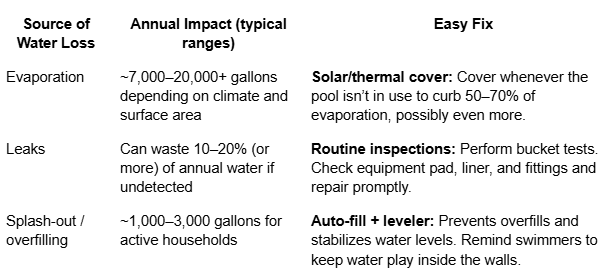
Evaporation is the number one culprit for ongoing water loss as splash-out, leaks, and filter backwashing add up too.
The good news: simple changes in operation and equipment can save thousands of gallons per year and keep your cost of filling a swimming pool lower over the long run. For context, EPA WaterSense (PDF) notes that an uncovered 500-sq-ft pool can lose tens of thousands of gallons annually to evaporation. Using a pool cover can prevent much of that loss.
8 Proven Ways to Conserve Pool Water (and Money)
- Install a Pool Cover: A solid or solar cover can reduce evaporation by 50–70% or more. It also helps retain heat and chemical levels. Use it daily when the pool’s not in use for the biggest impact.
- Optimize Filtration Cycles: Adjust pump runtimes based on actual use and water clarity instead of a fixed schedule. Smarter cycles save both energy and water by reducing unnecessary backwashing.
- Install Smart Monitoring: Leak detectors and water-quality sensors can catch small issues early. Automated alerts help you stay on top of maintenance, extending water life and avoiding waste.
- Lower Water Temperature Slightly: Heated pools lose more water to evaporation. Even a small temperature drop, paired with a cover, can reduce both water and energy loss.
- Use Cartridge Filters When Practical: Unlike sand filters, cartridge systems don’t need regular backwashing. That means less water loss and easier upkeep across the season.
- Maintain Proper Chemical Balance: Keeping water balanced prevents algae and scaling, reducing the chance you’ll need to drain and refill. Test weekly, and especially after storms or heavy use.
- Shock and Clean Filters Regularly: Routine shocking and filter cleaning keep water clear and usable longer, so you’re not forced to do a full water replacement due to contamination.
- Schedule Partial Refills: Instead of draining the entire pool when water quality dips, replace a portion. It uses far less water and often meets drought restrictions if you’re under conservation rules.

Alternative Water Sources and Treatment Options
Looking to cut the cost of filling your pool with a non-potable source? There are alternatives, but what’s allowed depends on local and state regulations. Before making plans to use harvested, well, or reclaimed water, check with your city or health department to avoid violations or safety issues.
Rainwater Harvesting:
- Cistern Collection: Large above- or below-ground tanks can collect roof runoff to offset water loss or contribute to the initial fill.
- Filtration & Disinfection Required: To meet recreational water standards, harvested rain typically needs sediment filtration followed by UV or chlorine treatment.
- Permits & Backflow Rules: Many municipalities require permits, air gaps, or backflow prevention when connecting to pool plumbing. Consult a licensed installer familiar with local codes.
Well Water:
- Mineral Content: Well water often contains iron, manganese, or other metals that can stain liners and surfaces without pre-treatment.
- Treatment Steps: Plan to test and balance pH and alkalinity, and add a metal sequestrant before filling.
- No Water Bill, Higher Power Use: While you avoid municipal water charges, your electric bill will rise due to the well pump running continuously during long fills.
Reclaimed or Gray Water:
- Highly Regulated: Most local health departments do not allow gray water (e.g., from showers or laundry) or untreated reclaimed water for pool use.
- State-Level Pathways (Limited Use): A few states—like Arizona, California, and Oregon—have formal programs for repurposing treated reclaimed water for specific uses like ornamental ponds or reservoir augmentation.
- Strict Treatment & Permitting: Any approved use still requires advanced disinfection, system monitoring, and explicit written approval.
- Default Rule: Unless your health department says otherwise, assume reclaimed or gray water isn’t allowed for pool filling.
Desalinated Water (Coastal Areas):
- Utility-Supplied: In coastal cities that use desalination plants, your water cost may already reflect higher production rates.
- No Special Treatment Needed: If desalinated water comes through your municipal system, it’s already treated. Just be aware it may carry a higher per-gallon rate.
How Royal Swimming Pools Helps Homeowners Save
At Royal Swimming Pools, we want your pool to be both fun and affordable to operate. We help you cut both one-time fill costs and ongoing top-off costs with equipment and guidance that prioritize water efficiency:
- Covers that pay for themselves: We carry solar and automatic covers that dramatically reduce evaporation and help stabilize water chemistry, two of the biggest drivers of refill volume.
- Energy-efficient pumps & smart run schedules: Variable-speed pumps and right-sized filtration let you circulate only as much as you need, trimming both energy and backwash water.
- Right-sized chemistry, fewer drain-and-refills: Start every season by knowing your exact pool volume with our Gallon Calculator. Accurate gallons make every chemical dose smarter, which extends water life.
- EPA-aligned best practices: We follow WaterSense guidance on evaporation control, leak detection, and maintenance so you can spend less on water without sacrificing water quality.
Eco-conscious pool ownership is good for your wallet and the planet. If you’d like help selecting the right cover, pump, or filtration setup for your pool, we’re here to help.